Noticias en ‘bears’

May 9th, 2008

Eco-tourism and bears in Somiedo

Following a rather sensational article in El Pais, an interesting polemical discussion is currently going on in the Spanish press. The original article centres on the dangers of bears becoming accustomed to human presence and approaching villages and their food sources, such as beehives, with the ensuing possibility of attacks on humans that this could incur. It refrains from mentioning that, in the north of Spain, bears and humans have lived side by side for hundreds of years resulting in no, or very little, danger on the part of the humans. In fact there exists a certain admiration and respect among the people of the Cantabrian mountains for their Ursine neighbours. The article also omits the very important factor of the lack of carrion around (an important part of the bear’s diet) due to the BSE laws enforcing the removal of carcasses from the countryside. Another concern raised is that foreign tour companies, in particular the British wildlife tour company Naturetrek, are endangering the future of the bears by disturbing them in their natural habitat.

Naturetrek deny they cause the bears any disturbance, a spokesman stating that their tours look for bears at a distance using public footpaths, though they don’t guarantee sightings. The Asturian tourist board and ecologist groups are of the opinion that this kind of tourism is endangering the growth and survival of the precarious Cantabrian brown bear population. However, bear specialist organisations and the mayor of Somiedo all envisage a future of guided and regulated wildlife-watching tours contributing to the local economy without disturbing the bears. A delicate balance.

Wildlife watchers in Asturias lne.es

Discovery of inhibitor produced by bears during hibernation

Scientists from Barcelona University have discovered that bears produce an inhibitor that prevents loss of muscle tissue during hibernation.  While their body temperature stays constant and they neither eat, drink nor defecate, proteins in the body produce a potent inhibitor that allows their muscle mass to remain as it was prior to hibernation leaving them able to move normally when they exit their dens in spring. The discovery could lead to a breakthrough in human medical care.

From terra.es

Pyrenean bear news

The last photo of Canelle?

The French hunter who in 2004 shot Canelle, considered the last autochthonous Pyrenean female bear has been absolved by a court, which believed the hunter’s version that he did so in self-defence after the bear attacked him. The death of Canelle caused outrage in France and led directly to the current reintroduction project of Slovenian bears. El Pais

Also in the Pyrenees, Guillermo Palomero, president of the Fundación Oso Pardo, notes that the Pyrenees still has enough habitat for a bear population to develop and stresses the role bears could play in increasing the need to combat the animal’s poor image here in contrast to the Cantabrian Mountains. (Aragon Digital). Some 15-20 animals survive on both sides of the border.

San Glorio ski resort project rejected by law courts

But great news for the Cantabrian mountains and their wildlife;

Photo of the San Glorio pass and beyond, taken early March 2007

The Castilla and León law courts have vetoed the project put forward by Tres Provincias S.A. for a ski resort in the San Glorio region of the Cantabrian mountains in the north of Spain, citing climate change as the main reason for its very doubtful economic viability. This makes it the first plan to have been denied on the grounds of climate change. The judgement points out that when, in 2006, the regional government of Castilla and León modified the laws protecting the Natural Park of Fuentes Carrionas and Fuente Cobre-Montaña Palentina (land included in much of the project) to enable the building of a ski resort, no scientific study was included to take into account the effects of climate change.

The threats to the environment and the future of the Cantabrian brown bear made by the project have led to huge opposition from conservationists, who have provided many environmental impact reports. The court also recognises that this project would be incompatible with the survival of many species of flora and fauna of the area, including the bears whose Eastern population would be severely affected.

News from El País

Read all about the subject on Iberianature forum

Snare traps still a threat to Iberian bears

The Spanish Brown bear foundation, Fundación Oso Pardo, has released figures of the illegal snare traps its patrols have removed in the Cantabrian mountains. Although the numbers have declined since they started their patrols, the figures are still alarming and continue to be a threat to the bears’ survival. These lethal wire traps are set mostly to trap wild boar and deer that cause damage to crops, though some are laid just for trophies and meat. Of the 1,155 snares discovered, most were found in Asturias. In 2004 the total found amounted to 225 but 2007 saw the figure drop to 67. However, in the area of Ancares, on the borders of Lugo (Galicia), Asturias and León, 130 have been removed in the last 5 years by one of the foundation’s patrols and, in the same area, 63 snares were found in the days between Feb. 27th and the 1st of March this year. These figures are without taking into account the snares removed by Fapas who are also working in this conservation area. It is hoped that continued education and intensive searches will see figures drop further. Sadly, due to the obstacle of not being able to provide proof, most cases go unprosecuted.

According to the newspaper, La Voz de Galicia, there is hope among conservationists (and conservation-minded locals) that the bears will begin to recolonise parts of Galicia.

Comment on this article on the forum

Illegally set snares

Photo from Fapas

Posted by Lisa

Sixteen bears in Trubia valley

Bears trashing hives in the Valle del Trubia (Fapas)

The number of bears identified in the Trubia valley in Asturias, from Quirós towards Oviedo, has doubled from eight in 2006 to sixteen in 2007. At least three breeding females have been identified who appear to be having few problems raising their cubs, leading to a lower infant mortality rate in this area than in other parts of the Cantabrian mountain chain. An abundance of food in the lower wooded valleys for these opportunistic animals, combined with recent mild winters, have contributed to this success. From Fapas.

(More wild neighbours for the semi-captive female Cantabrian brown bears in the same valley, Paca and Tola, who are presently awaiting a suitor in their new enclosure in Proaza in a plan to test their fertility with a captive male European brown bear from the Cabárceno safari park in neighbouring Cantabria previous to finding a suitable wild, male Cantabrian brown bear.)

By Lisa

Exhibition of photographic monitoring work by Fapas

An exhibition starts tomorrow, 4th of March, 2008 in La Casa Encendida, Madrid (Ronda de Valencia, 4) of the photographs taken automatically by Fapas as part of their photographic monitoring work of the Cantabrian brown bears. Continuing through ’til the end of the month, the exhibition will be kicked off on the 4th at 19:30 with a talk by Alfonso Hartasanchez on his work tracking the bears by cameras mounted in the Cantabrian mountains.

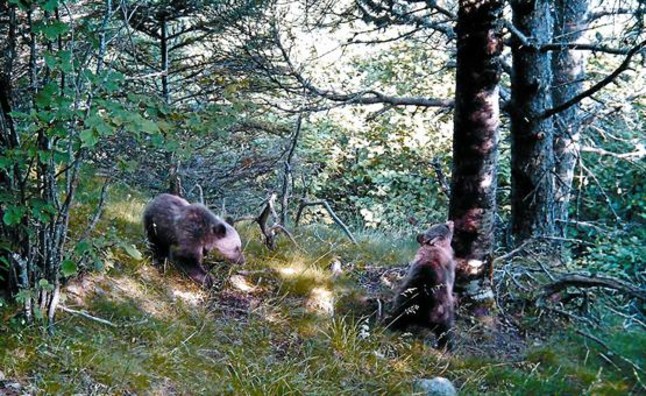
Bear cub learning how to mark territory

Bear death case re-opened

From ABC.es;

The case of the Cantabrian brown bear found dead in the Polentinos region of the Cantabrian mountains on the 11th of August, 2007 has been re-opened to finally establish the cause of death.

www.picos-accommodation.co.uk

The Cantabrian brown bear on Wikipedia

The Cantabrian brown bear (Ursus arctos) now has its own page on Wikipedia which will, hopefully, be of interest to a worldwide readership and bring it more attention internationally. There’s information on the tricky subject of the scientific classification of Ursidae species as well as threats that are currently confronting the bears’ survival and the conservation measures being undertaken to combat them to ensure their continued presence in Spain.

Cantabrian brown bears, Fapas

Posted by Lisa

www.picos-accommodation.co.uk

Dead livestock to be left in Picos

Good news. Dead livestock is to be left uncollected in the Picos de Europa for the first time since 2001 when the EU banned the practice due to Mad Cows’ disease. At present some 20,000 dead animals are removed every year from the Spanish countryside which otherwise would have formed part of the food chain. (Fapas)

I am at present unsure as to whether the dead livestock is to be collected in special areas only for carrion birds, or whether, mammals such as brown bears will also be able to benefit. Attacks by bears on fruit trees and beehives have increased dramatically since the ban as carrion forms an essential part of their diet.

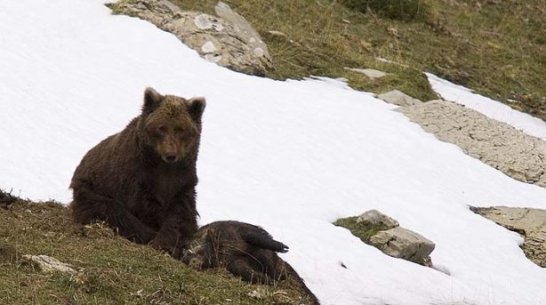
Below a bear in Somiedo tucks into a mule (?), exempt from the Mad Cow rule. (Fapas)

See also archive on BSE and wildlife in Spain

Bear died accidently

An autopsy has shown that the bear found dead in Fuentes Carrionas last week died an accidental death from a cranial injury possibly due to a fall. An example, I think, of the danger of jumping to conclusions. (Fapas)

Bear found dead in Palencia

The second brown bear in a month has been found dead in Palencia, in the Parque Natural de Fuentes Carrionas y Fuente Cobre. Environmental groups have denounced the widespread use of poison in the area. A bear was found dead in the same area in August 2007. An autopsy revealed that it had been poisoned with carbofuran. (El Pais)

Paca and Tola

Paca and Tola are two female bears which were orphaned 1989, at the age of four months when a hunter killed their mother and took the two cubs. The cubs were rescued by Fapas and Seprona after a tip-off and now live in semi-captivity in a large mountainside enclosure. Now they are to be mothers.

Photo of Tola and additional research by Lisa of picos-accommodation

The Fundación Oso de Asturias plan to mate them with a another male bear used to captivity in spring 2008, when they come into heat after hibernation. (LNE) The problem is that there is currently no captive male Cantabrian bear, so a bear from another “group” is probably to be used. I use the term “group” as the extistence of Ursus arctos Cantabricus as a separate sub-species is under debate.

The two bears live in a 5000m2 mountainside enclosure and have become a popular tourist attraction and have played a very important role in raising environmental awareness about bears in Asturias. Watch them here . There are references to bears almost every week in the local press and people love talking about them. One has the impression that bears in general and Paca and Tola specifically are quasi-nationalist symbols in Asturias, and much loved…unlike wolves.

Most of the time you can’t see them as their hidden in the rocks, scrub and trees, but they come down at 12:00 am every day to eat. I saw both Paca and Tola taking a bath this August as we all watched on, sweltering outside their enclosuse. The enclosure is in the beautiful Concejo de Trubia. Paca at the end of an excellent cycle path which runs along an old mining railtrack, known as La Senda del Oso. The path (or rather network of paths) runs through tunnels, across bridges and through a spectacular gorge. Reasonably-priced cycle hire is available at each end. They’ve also got cycle with back seats for little kids which is what we used. More here

Read the forum thread on Paca and Tola here

Bears breeding near Oviedo

According to Fapas, bears are coming closer and closer to Oviedo in the valle del Trubia.  A female bear with cubs has been detected within 8 kilometres of the city’s administrative limits, the first time cubs have been detected in the Trubia for ten years. This central area now seems to comprise three breeding females and is an essential step in joining the two separate bear populations.  LNE

The Cantabrian brown bear

Lisa of the iberianature forum has written this excellent piece on the Cantabrian brown bear for the Olive Press with which she begins:

“CANTABRIAN brown bears have developed a slightly different genetic identity to other brown bears, including the European. This is due to the geography of the Iberian peninsula effectively cutting them off from other populations to the North. However, they have not been recognised by the scientific community as a distinct subspecies, being referred to as simply Ursus arctos. Read 

Lisa runs this rather nice guesthouse in the Picos. Go there and discuss bears over breakast with her. Photo of Cantabrian bear nabbed from here site.

The bear and the princess

The Monasterio de San Salvador in Cornellana, Asturias was founded in 1024 by Princess Cristina, daughter of King Bermudo II of Leon, also known as Bermudo el Gotoso (Gout-stricken). The gate into the vegetable garden is decorated with the relief of what is perhaps a female bear breast-feeding a human child. The legend goes that when Cristina was a young girl she got lost in the forest and was saved by a bear which fed and protected her.

The tale of the bear’s paw

This video poetically tells the story of a bear’s claw nailed to a church in the village of Navacepeda de Tormes in the Sierra de Gredos. The old people say a man had been attacked by a bear and had defended himself with scythe. Bears became extinct in Gredos at some point in the 16th century. Kindly sent to me by Claire of Gredosvivo, bird watching tours in central-western Spain. The video was researched and made by Enrique Sacristán. Also available in Spanish.

Bear deaths

Lisa of picos-accommodation has reported on the forum on these lamentable bear deaths in Spain during the summer. Follow the thread on the forum

“Franska, the female bear accused of having killed 150 sheep in the Pyrenees, was killed in a road “accident”" near Lourdes last Thursday (9th) at 6.30am. Her search for territory has ended. Photo below from Fapas. An autopsy has revealed dozens of small calibre gun shot pellets were found in her body dating from weeks before.  Her bullet-ridden body is being blamed for her erratic behaviour (farmers blame her for the death of 150 sheep in a couple of months) The autopsy also revealed her age as being 17 and not 7 as the Slovenian authorities had stated.”


“Environment news from consumer.es regards the death as suspicious. Had she been regularly crossing the road at that point I wonder? Of the five Slovenian bears reintroduced to the Pyrenees, there are now three remaining. Another female was found dead at the foot of a cliff not long after being released.”

“Sadly, another dead bear from elmundo.es; A dead bear has been found in a field in the Palentine area of the Cordillera (we were driving in the area yesterday) and tests are being carried out to try and establish the cause. As the photo shows, much of the corpse has been eaten by other animals. The bear was about 20 years old so it could have died of natural causes (on open ground??) although in the last few years, 9 bears have been found dead in this area; 6 poisoned, 2 shot and one cause of death unknown. Possibly, cubs could be added to this list affected by the death of mothers”

Bears and wolves threatened by EU carrion ban

As previously reported on Iberianature, bears, wolves and other wildlife in Spain are seriously threatened by the EU dead livestock ban arising from the BSE outbreak. 8-10 bear cubs are estimated to have died in 2006 because of the ban. Just in Asturias, 210,300 kg of dead meat are now removed every year which before was an essential food source for many animals, despite the fact that not a single case of BSE has been detected in the region. (El Mundo). The issue is currently being taken up by Spanish MEPS in the EU (Fapas)

Bear eating carrion

Bear eating carrion in Asturias (FAPAS) See also Good news for carrion birds + spainbearnews

Bears return to Belmonte de Miranda

According to Fapas, bears have returned to the area of Belmonte de Miranda. 18 different animals have been detected in the last two years including 4 breeding females. This area of deep valleys and dense forests is now considered vital to the bear’s conservation in Asturias. The lack of carrion because of the prohibition of leaving dead livestock because of mad cow’s disease means it is difficult for the animals to find enough food leading to problems such as raids on beehives. More here from Fapas

Short video here from Asturias TV. Click on the image

beehive bear

Beehives trashed by bears in Belmonte de Miranda